


About The MosaiQs
See the bigger picture.
Recognise the patterns.
Make better decisions about what happens next.
The MosaiQs
The MosaiQs is a framework ecosystem built to help you step back, recognise what’s really going on, and understand how the different pieces of life come together.
It exists to make complexity easier to see, understand, and work with.
The work brings together lived experience, cultural insight, and structured thinking to show what is actually shaping a situation and how it influences outcomes.
Built on The MosaiQs Mindset, expressed through the Model, and applied through the Method, the work connects pieces most approaches treat separately.
Because the barriers people face rarely sit in one place.
And they almost never exist in isolation.
The MosaiQs Model
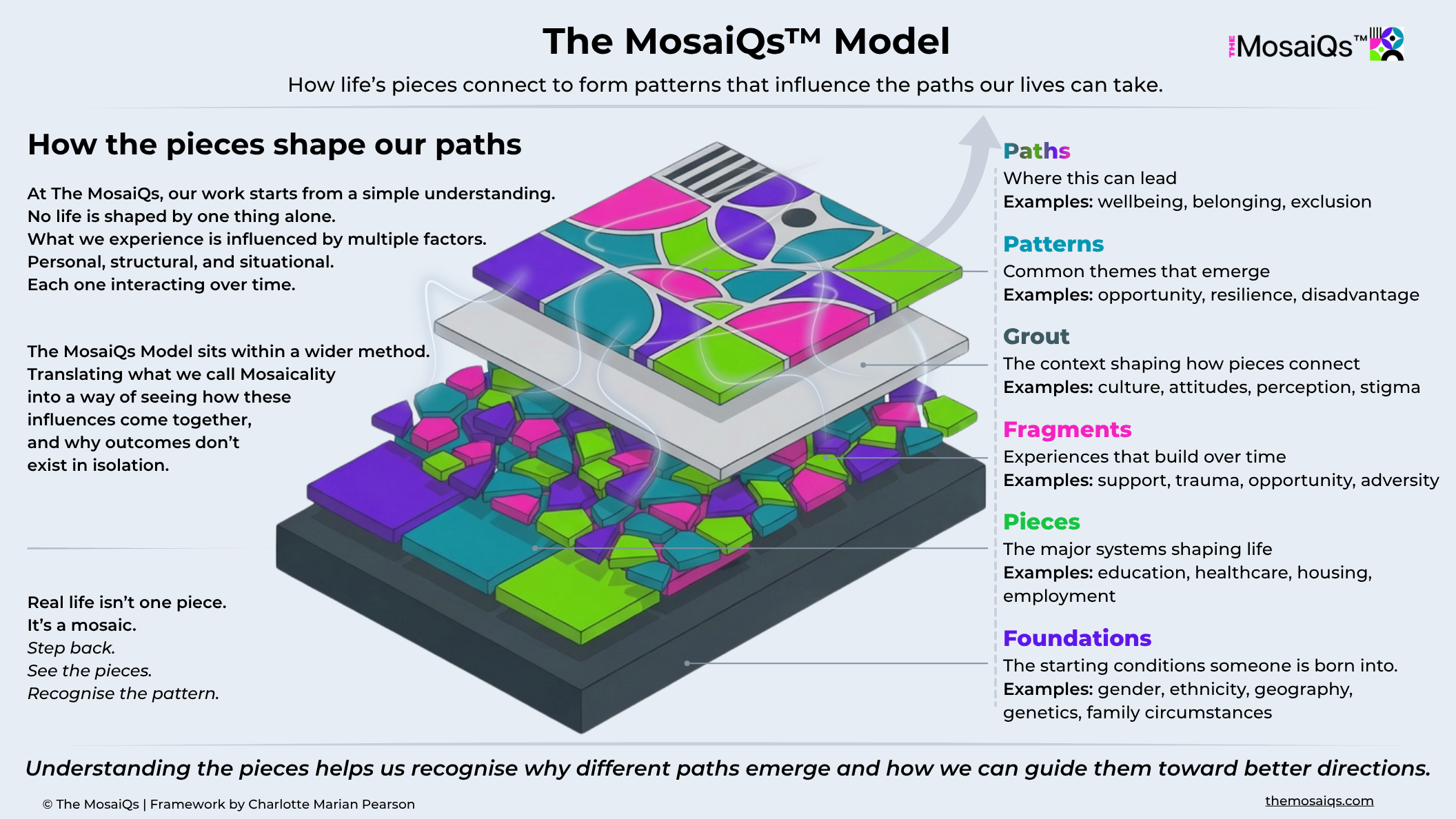
We designed this as a visual tool to show how patterns and outcomes form.
Not from a single factor.
From the interaction between the pieces that make up life’s mosaic.
Foundations. Pieces. Fragments. Grout.
Together, they explain what’s really going on.
Step back. See the pieces.
“You can’t change outcomes if you only look at outcomes.”
Mosaicality
Mosaicality recognises that life is shaped by multiple interacting elements.
From the foundations we begin with,
to the systems around us,
to the everyday experiences that shape how life is actually lived.
When you see how those elements interact, patterns start to make sense.
Context matters.
Nuance matters.
And real life is rarely as tidy as people want it to be.
The MosaiQs Mindset
The MosaiQs is about seeing how things actually connect.
For a long time, the closest language for this way of thinking sat in separate areas.
Inclusion.
Structures.
Identity.
Culture.
Strategy.
Lived experience.
Each one explains something.
But none of them explain the whole.
Different factors.
Different pressures.
Different perspectives.
Some visible.
Some not.
Some known.
Some not yet understood.
Which means what you are looking at is rarely the full picture.
What is actually happening is not one lens. It is many.
Working together.
Shaping each other.
Changing over time.
Life is not fixed or predictable.
It is layered.
It is contextual.
Often messy.
Always shifting.
When you recognise that,
you stop forcing things into neat explanations.
You start to see how things connect.
How context changes meaning.
How the same situation can unfold
in completely different ways.
How outcomes are shaped over time,
not just in moments.
Not as separate ideas.
But as something interconnected.
Not because it becomes simple.
But because it’s clearer.

-
Zoomed in
Too focused on one detail and treating it as the full explanation.
A behaviour becomes the story.
A label becomes the life.
One moment gets asked to explain everything that came before it.The context drops out.
The build-up disappears.
Everything surrounding it gets pushed to the edges.You are so close to one tile you can see the texture,
but not the pattern.It feels precise.
It feels certain.But a close-up is not the whole story.
-
Wrong angle
Looking from a partial, biased, or limited perspective and calling it the full picture.
Seeing one side and assuming you have seen enough.
Mistaking a skewed view for objectivity.You can be looking right at something and still miss it, if your angle is off.
Where you stand shapes what you notice.
What you notice shapes what you think matters.
And what you miss quietly changes the meaning of everything.The read can still sound intelligent.
Measured.
Certain.That does not make it complete.
The angle is off, so the read is off.
-
Out of focus
Blurry understanding presented as clarity.
Responding before the picture has properly come into view.
You can tell something is there.
But the edges are soft, the detail is patchy, and the gaps are being filled in with assumption.It sounds decisive.
It looks like action.
It gives the impression that someone has got a handle on things.But it is built on something half-seen.
Low-resolution thinking shaping real decisions.
And when the focus is off,
the response will be too. -
Not looking properly
Avoidance, dismissal, or selective attention.
Looking away from what does not fit.
Filtering out what feels inconvenient.
Deciding what matters before actually seeing what is there.The information is there.
The signals are there.
The tensions are there.But they do not fit the version people are comfortable with,
so they get skimmed over, toned down, or quietly ignored.Not always dramatically.
Sometimes just enough to change the conclusion.And then the final read gets presented as if everything was considered.
It wasn’t.
Sometimes the issue is not confusion.
It is avoidance.
Or, at best, selective attention dressed up as clarity.
-
Too far removed
Detached from lived reality.
Making decisions from a distance, without any real feel for what is happening on the ground.
You are looking at the picture from another room.
Through a summary.
Through someone else’s version of events.
Through people who are confident, polished, and nowhere near the actual thing.From that distance, everything looks tidier than it is.
More manageable.
More straightforward.
Less human.The detail is gone.
The contradiction is gone.
The parts that make the picture make sense have already been flattened out.It sounds good in theory.
It just does not hold when real life turns up.
-
Obstructed view
The picture is there.
But something is standing in the way.
Noise.
Ego.
Performance.
People more focused on being seen near the picture than understanding it.Voices speaking over those closest to the reality.
People positioning themselves as experts without depth.
Spaces crowded with visibility, but lacking clarity.Too many people at the front.
Not enough people who actually understand what they are looking at.And the impact is real.
The people closest to the reality get drowned out.
The people trying to help get poor information.
Decisions are shaped by performance instead of insight.
And the clearest voices get pushed to the edges.The loudest voice is not always the clearest.
Sometimes the issue is not the picture. It’s the view.

Meet the Founder
Charlotte Marian Pearson is the founder of The MosaiQs.
Her work sits across media, education, policy, and culture, shaped by over 15 years of lived experience, cross-sector work, and community-led insight.
She works alongside organisations, institutions, and decision-makers to challenge assumptions, reframe complexity, and bring clarity where outcomes are not aligning with intention.
Her perspective is grounded in real-world experience.
Not just observing systems, but navigating them.
Not just analysing outcomes, but living them.
This is what gives the work its depth.

Charlotte’s work has contributed to national conversations, public platforms, and decision-making spaces where real-world outcomes are shaped.
This includes:
Media contributions and advocacy, including ITV News, supporting shifts in understanding and response during the pandemic for SEND families
Policy and community-led work through Citizens UK, contributing to campaigns influencing support and funding
Cultural and industry platforms, including Cannes Lions, where she was invited to speak within the Talent and Cultures programme
Editorial and media contributions, including The Washington Post and WeTransfer, recognised for bringing grounded, real-world perspective into complex conversations
She is known for bringing clarity to complexity, and for asking the questions that change how situations are understood.
The MosaiQs is an extension of that work.
A structured way of seeing what is often missed.
And using that understanding to shape better outcomes.
Adopt the Framework
The MosaiQs connects the pieces most approaches treat separately. If your work requires this level of systemic clarity, there are multiple ways to connect with the framework.
See the bigger picture. Then do something useful with it.
If this is the level of clarity your work requires, this is where the conversation starts.